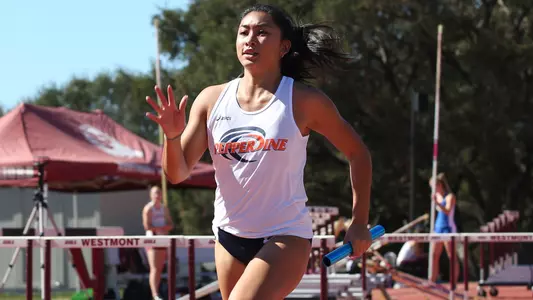
Photo by: Jeff Golden
Women's Track Q&A: Caila Tongco
2/4/2019 9:24:00 AM | Track, Competing With Purpose Blog
Sophomore Caila Tongco is back and better this season for the Pepperdine's women's track team. Her injury last season only motivated her to break her own 60-meter indoor track record in the first meet of the weekend. We discussed the effects of her injury and how it drove her to making a record-breaking comeback this season:
Q: You have got off to a nice start last year as a freshman when you set the indoor record in the 60-meter hurdles. What would you attribute last year's success to?
A: I would just say I knew that the record was achievable coming in as a freshman, especially because my PR for the 60 hurdles as a senior in high school was faster than the record I needed to beat. Coming in with that mindset made me less nervous to try to beat it because I had already ran a time faster than that. But I did come in with an injury from my senior year that had me out for nine months after my Achilles tendon ruptured.
Q: After setting the record and only competing in two outdoor meets, you got injured. How did this injury affect you?
A: I didn't see it as an injury as first, I thought it was just a weird pain I should get checked since the pain in my right foot was different from the pain in my left foot. So I figured I should just get it checked out and I ended up needing an MRI. The Injury wasn't detrimental in any way, but they wanted me to be proactive because it was a stress reaction that happens before a stress fracture. Technically I was fine, but if I kept running I would have eventually had a stress fracture so they strongly advised me to rest for four weeks. I decided to stay out for the entire outdoor season because four weeks was more than half of the season and I didn't see the point of coming back for two weeks when I could medically redshirt and have one more eligible year of competition.
Q: How hard was it to sit out?
A: It was really hard, because I knew the injury wasn't something that was stopping me from running. When I got injured my senior year I literally couldn't walk, I had surgery and then had soft and hard casts for six weeks. After I got the cast off, I couldn't walk for two weeks after that, so it wasn't hard for me to sit out because I physically could not run. But last year was hard because I could walk and could run if I really wanted to but I had to be mentally disciplined instead of physically incapable.
Q: How hard was it to come back and continue your success?
A: It wasn't really hard because I was out for a month and I could start doing things again after that. I didn't lose hope because I knew the rest was for a good purpose. Then over summer I competed and it felt good because my first outdoor meet here was not good enough for me personally. I ran a slow time, which made me want to work even harder.
Q: How did it feel to break your own 60-meter hurdles indoor record in the first meet of the season?
A: It felt really good, and I came in with the mindset that I needed to beat the record. So actually accomplishing that was really satisfying after all that I've endured the past few years. I hope to stay healthy and actually finish a season because I haven't finished an entire season since my junior year of high school. But, I am not exactly where I want to be yet. There is room for improvement.
Q: What were your overall thoughts on the first meet?
A: Overall it was successful, I broke the record for the 60 hurdles, and ran the 200 and 60 open, which I also PRd in. It was really cool for me because I got meet experience a college meet for the first time in a while. It was also my first time making it into a semifinal for the 60 hurdles. I ran against a girl from USC who was the third-fastest in the country. I haven't ran against such high competition so that gave me another great experience because I was nervous this time, but next time I won't be.
Q: What would you attribute this record to?
A: First off, constantly having the mindset that it's a goal that you need to reach or break. In high school my coach made me write my time down and set it as my phone screensaver so every time I looked at my phone screen the time was there to constantly remind me of what I needed to do. It taught me that your goal is something that constantly needs to be on your mind. In the three weeks over break I worked out even when I had no accountability but my self-discipline of knowing that I needed to train and work hard helped me to train over break along with the motivation from my coach and trainer. This is why I am where I am now.
Q: What are your time and personal goals for this season?
A: For indoor I want to run under nine seconds. My PR from high school career is 9.1 but I want to run under nine because it would be a big confidence booster for my outdoor season. In the 100 hurdles I want to get back down to my PR of 14.4. For the 200 I want to get into the 25-second range and for the 100 I want to hit low 12's. It is not too hard of a time to hit but I know that it's a reasonable time and that will also help with the team's 4x1 relay.
Q: How does your sports medicine major correlate with your own experience in sports?
A: It definitely helps me to be more educated in the reasoning behind doing certain workouts. It also makes me more curious in asking my coaches from here and at home more questions on why they are have me do this specific workout. They usually tell it is to work this or that muscle or this or that body system and being able to understand that language helps me understand my own body down to the scientific aspects. It gives me a purpose to my workouts. I also do not have to go into anything blindly. For example, I know why it is beneficial for me to take a 30-second break in between sprints.
Q: You have got off to a nice start last year as a freshman when you set the indoor record in the 60-meter hurdles. What would you attribute last year's success to?
A: I would just say I knew that the record was achievable coming in as a freshman, especially because my PR for the 60 hurdles as a senior in high school was faster than the record I needed to beat. Coming in with that mindset made me less nervous to try to beat it because I had already ran a time faster than that. But I did come in with an injury from my senior year that had me out for nine months after my Achilles tendon ruptured.
Q: After setting the record and only competing in two outdoor meets, you got injured. How did this injury affect you?
A: I didn't see it as an injury as first, I thought it was just a weird pain I should get checked since the pain in my right foot was different from the pain in my left foot. So I figured I should just get it checked out and I ended up needing an MRI. The Injury wasn't detrimental in any way, but they wanted me to be proactive because it was a stress reaction that happens before a stress fracture. Technically I was fine, but if I kept running I would have eventually had a stress fracture so they strongly advised me to rest for four weeks. I decided to stay out for the entire outdoor season because four weeks was more than half of the season and I didn't see the point of coming back for two weeks when I could medically redshirt and have one more eligible year of competition.
Q: How hard was it to sit out?
A: It was really hard, because I knew the injury wasn't something that was stopping me from running. When I got injured my senior year I literally couldn't walk, I had surgery and then had soft and hard casts for six weeks. After I got the cast off, I couldn't walk for two weeks after that, so it wasn't hard for me to sit out because I physically could not run. But last year was hard because I could walk and could run if I really wanted to but I had to be mentally disciplined instead of physically incapable.
Q: How hard was it to come back and continue your success?
A: It wasn't really hard because I was out for a month and I could start doing things again after that. I didn't lose hope because I knew the rest was for a good purpose. Then over summer I competed and it felt good because my first outdoor meet here was not good enough for me personally. I ran a slow time, which made me want to work even harder.
Q: How did it feel to break your own 60-meter hurdles indoor record in the first meet of the season?
A: It felt really good, and I came in with the mindset that I needed to beat the record. So actually accomplishing that was really satisfying after all that I've endured the past few years. I hope to stay healthy and actually finish a season because I haven't finished an entire season since my junior year of high school. But, I am not exactly where I want to be yet. There is room for improvement.
Q: What were your overall thoughts on the first meet?
A: Overall it was successful, I broke the record for the 60 hurdles, and ran the 200 and 60 open, which I also PRd in. It was really cool for me because I got meet experience a college meet for the first time in a while. It was also my first time making it into a semifinal for the 60 hurdles. I ran against a girl from USC who was the third-fastest in the country. I haven't ran against such high competition so that gave me another great experience because I was nervous this time, but next time I won't be.
Q: What would you attribute this record to?
A: First off, constantly having the mindset that it's a goal that you need to reach or break. In high school my coach made me write my time down and set it as my phone screensaver so every time I looked at my phone screen the time was there to constantly remind me of what I needed to do. It taught me that your goal is something that constantly needs to be on your mind. In the three weeks over break I worked out even when I had no accountability but my self-discipline of knowing that I needed to train and work hard helped me to train over break along with the motivation from my coach and trainer. This is why I am where I am now.
Q: What are your time and personal goals for this season?
A: For indoor I want to run under nine seconds. My PR from high school career is 9.1 but I want to run under nine because it would be a big confidence booster for my outdoor season. In the 100 hurdles I want to get back down to my PR of 14.4. For the 200 I want to get into the 25-second range and for the 100 I want to hit low 12's. It is not too hard of a time to hit but I know that it's a reasonable time and that will also help with the team's 4x1 relay.
Q: How does your sports medicine major correlate with your own experience in sports?
A: It definitely helps me to be more educated in the reasoning behind doing certain workouts. It also makes me more curious in asking my coaches from here and at home more questions on why they are have me do this specific workout. They usually tell it is to work this or that muscle or this or that body system and being able to understand that language helps me understand my own body down to the scientific aspects. It gives me a purpose to my workouts. I also do not have to go into anything blindly. For example, I know why it is beneficial for me to take a 30-second break in between sprints.


Players Mentioned

Sprints
/ Track